
The Agentic Inference Checklist: How To Evaluate Your Infrastructure And Deploy Small Language Models For Speed and Cost Reduction
Use this checklist to identify places to make your

Most companies running AI in production are overspending on inference — and they don’t know it.
The default behavior is understandable: send everything to the biggest, most capable model available, because why risk a worse answer? But this approach ignores a fundamental reality about how AI systems actually work. The vast majority of inference calls in a production system aren’t hard. They’re repetitive, narrow, and well-defined. And for those tasks, a Small Language Model fine-tuned on the right data will often match or beat a frontier model — at a fraction of the cost and at a much lower latency.
The opportunity isn’t theoretical. It’s an architectural audit away. Here’s how to find it.
Start by Mapping Every Inference Call
Before you can optimize anything, you need visibility. The first step is cataloging every point in your system where a model is being called. For each one, document the task type (classification, extraction, summarization, generation, reasoning), the input and output complexity, the latency requirement, the accuracy threshold, and the call volume.
What you’re building is a heat map. You want to see where you’re spending inference dollars and, critically, where the performance bar actually sits. Most teams discover that a large percentage of their calls are going to a frontier model for tasks that don’t require frontier-level intelligence.
Know What Makes a Workload SLM-Eligible
Not every task is a candidate. But the signals are consistent once you know what to look for.
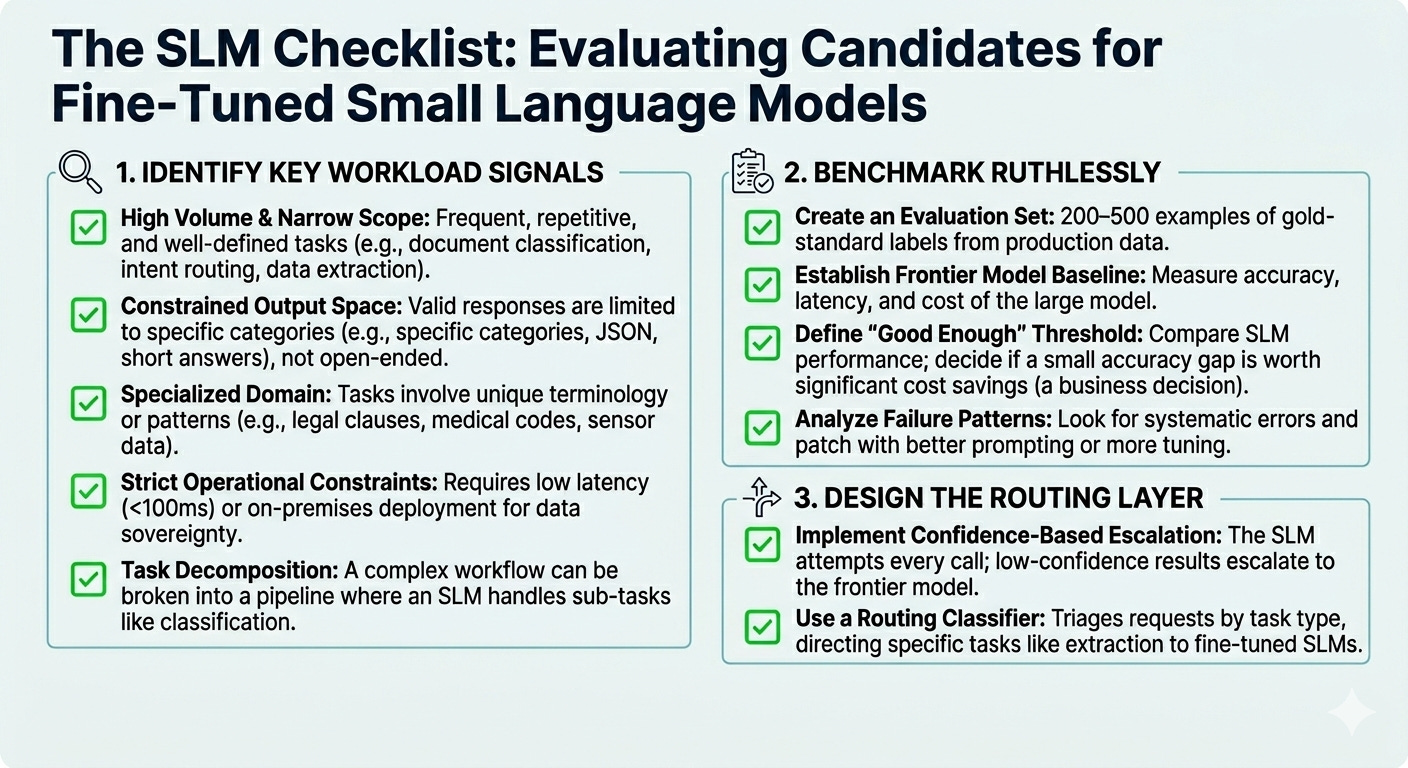
High volume and narrow scope is the single biggest indicator. If a task is repetitive and well-defined — classifying documents into known categories, extracting entities from structured inputs, routing user intents, generating text from templates — a fine-tuned SLM will handle it efficiently. This is what I call the “jagged frontier” in action: task-specific performance doesn’t correlate neatly with parameter count. Bigger isn’t always better when the problem is small.
Constrained output spaces are another strong signal. Anytime the valid response is one of N categories, a structured JSON object, or a short extractive answer, you’re looking at a narrow decision surface. A small model doesn’t need to know everything — it just needs to navigate that surface reliably.
Specialized domains favor SLMs as well. Legal clauses, medical codes, financial filings, and industrial sensor data all involve repetitive vocabulary and patterns. The relevant knowledge surface is compact, which means a fine-tuned small model absorbs it efficiently.
Latency and data sovereignty can make SLMs not just preferable but necessary. Sub-100ms response requirements and on-premises deployment constraints often rule out frontier models entirely, regardless of budget.
And then there’s the most architecturally interesting pattern: task decomposition. A single complex prompt to a frontier model can often be broken into a pipeline where SLMs handle extraction and classification while the large model only touches the genuinely hard reasoning step. The composite system costs a fraction of the monolithic approach and frequently performs better, because each stage is optimized for its specific job.
Benchmark Ruthlessly
Identifying candidates is the easy part. Validation is where discipline matters.
For each candidate workload, build a task-specific evaluation set of 200 to 500 examples with gold-standard labels, drawn from production data. Establish the frontier model baseline — accuracy, latency, and cost per call. Then test two or three SLM candidates both zero-shot and fine-tuned.
The critical conversation happens next: defining “good enough.” If the frontier model scores 94% and the SLM scores 91%, is that three-point gap worth a 10 to 50x cost reduction at scale? For most classification and extraction tasks, the answer is yes. For high-stakes medical or legal reasoning, maybe not. The threshold is a business decision, not a technical one.
Pay close attention to failure patterns. Random errors are tolerable at low rates. Systematic failures — where the SLM consistently mishandles a specific input class — can often be patched through better prompting, additional fine-tuning, or a confidence-based escalation to the larger model.
Design the Routing Layer
Once you’ve validated your SLM workloads, the architecture question becomes: how do calls get to the right model?
The highest-leverage pattern is confidence-based escalation. The SLM handles every call, and when its confidence score drops below a threshold, the request escalates to the frontier model. In practice, this captures 70 to 85 percent of volume at SLM cost while preserving quality on the difficult tail. A lightweight routing classifier — itself often an SLM — can also triage requests by task type, sending extraction to the fine-tuned small model and open-ended reasoning to the large one.
In The End
The companies that will run AI most profitably aren’t the ones with access to the best models. Everyone has access to the best models. The winners will be the ones who understand which model to use where — and build the infrastructure to route accordingly.
The audit isn’t complicated. Look for high-volume, narrow-scope, constrained-output tasks with specialized vocabularies and strict latency or sovereignty requirements. Benchmark aggressively. Define your “good enough” thresholds. Build the routing layer.
The frontier model is a sledgehammer. Most of your nails only need a finish hammer. Knowing the difference is where the margin lives.
If you want to automate this process, that’s what we do at Neurometric, so please reach out for a demo.
The confidence-based escalation pattern maps neatly onto what's happening at the market level. OpenRouter does something similar across 300+ models, routing 30 trillion tokens monthly by matching the right model to each request. I reckon the companies that nail this routing early will have a real edge as agent workloads scale up. Agents don't care which model responds; they care about cost per outcome. Wrote about the macro economics of this recently: https://medium.datadriveninvestor.com/who-profits-when-ai-models-are-free-b71ae03f4167
The nuance in "Most companies running AI in production are overspending on inference — and they don’t know it" is something most posts on this topic miss. Saving this for reference. The distinction you draw here is exactly what teams need to internalize before scaling.