
How Sophisticated Enterprises Deploy AI
How to think about task based endpoints

When we first launched the core Neurometric platform, we pitched a lot of Fortune 1000 companies on what we were doing. Most of them aren’t as far along in AI as they want to be, but the handful that were had all made the exact same deployment decisions. What we learned drove a new product architecture for Neurometric.
Every company was have spoken to that is advanced enough in AI to be doing some serious inference work gets to a point where their inference charges are high and growing fast. At that point they look at their most high volume agentic workloads and they break them out into “task specific endpoints.”
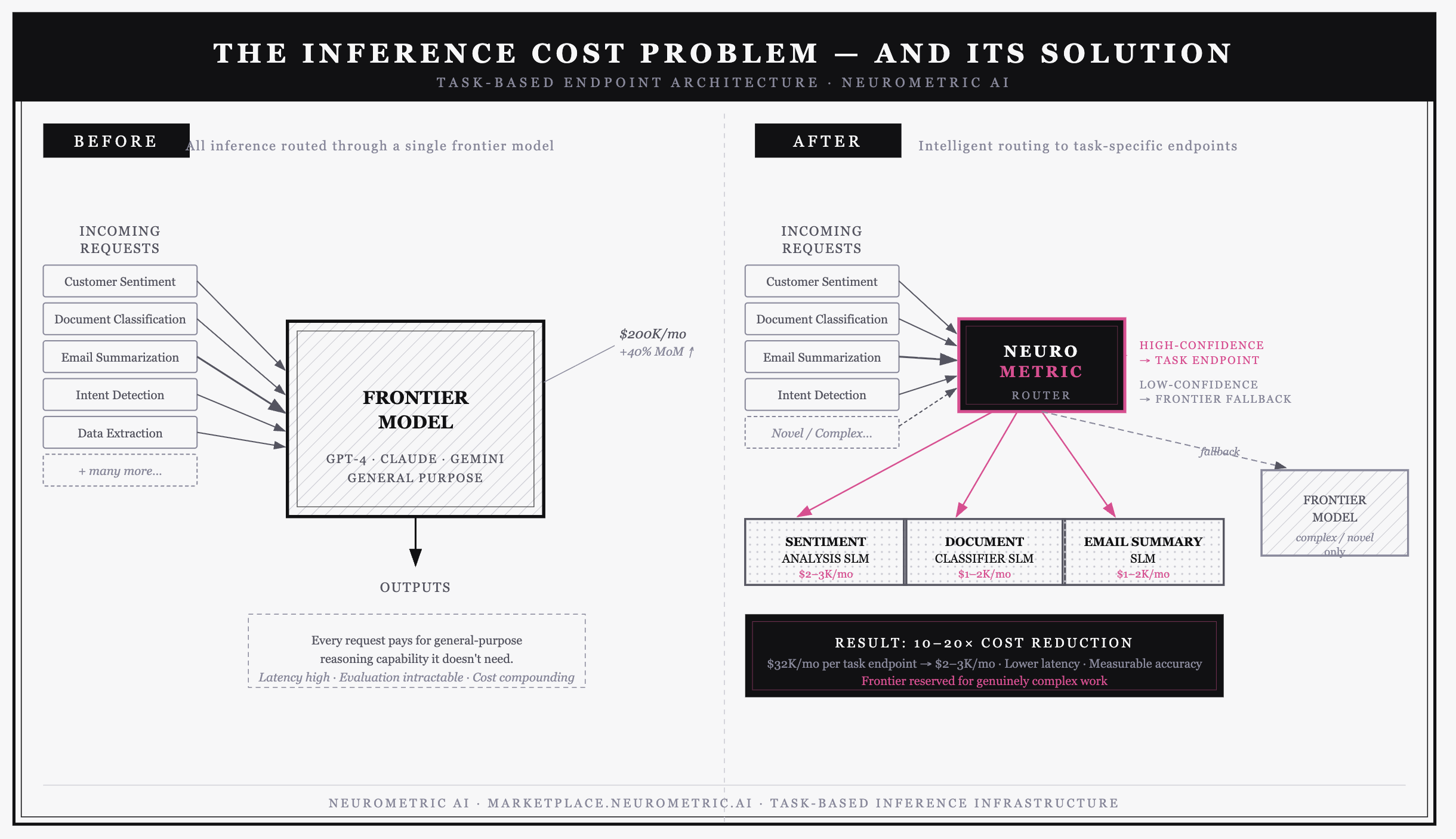
As an example, say you are spending $200K per month on inference on a frontier model, growing at 40% month over month. That cost is going to explode. What we’ve seen people do in that situation is identify the most common workloads, say the top one is customer sentiment analysis, at $32K per month. They setup a single endpoint with a smaller model focused exclusively on that task.
The economics are immediately obvious. A frontier model charges for general-purpose reasoning capability you don’t need when the task is well-defined and repetitive. A smaller model, fine-tuned or prompt-engineered for a single task, can match or exceed frontier accuracy on that narrow domain at a fraction of the cost — often 10-20x cheaper per token. That $32K line item becomes $2-3K. Multiply that across your top five workloads and you’ve carved out a majority of your inference spend.
But the benefits go beyond cost. Task-specific endpoints are faster. There’s no overhead from a generalist model reasoning through ambiguity it doesn’t need to resolve. Latency drops, throughput increases, and because the model is doing exactly one thing, evaluation becomes tractable. You can actually measure whether it’s working.
The architecture pattern is straightforward: a lightweight router sits in front of your inference layer and classifies incoming requests by task type. High-confidence matches get dispatched directly to the appropriate task endpoint. Low-confidence or novel requests fall back to the frontier model. Over time, as you identify new high-volume task clusters, you spin up new endpoints and your frontier model handles a shrinking share of total volume — reserved for the genuinely complex, ambiguous work it was built for.
At Neurometric, we’ve built the tools to make this easy. We are the infrastructure layer that makes task-based routing operationally viable at enterprise scale. Small fast models easy to build, manage, and deploy. Let us know if we can help you setup a task based endpoint architecture.